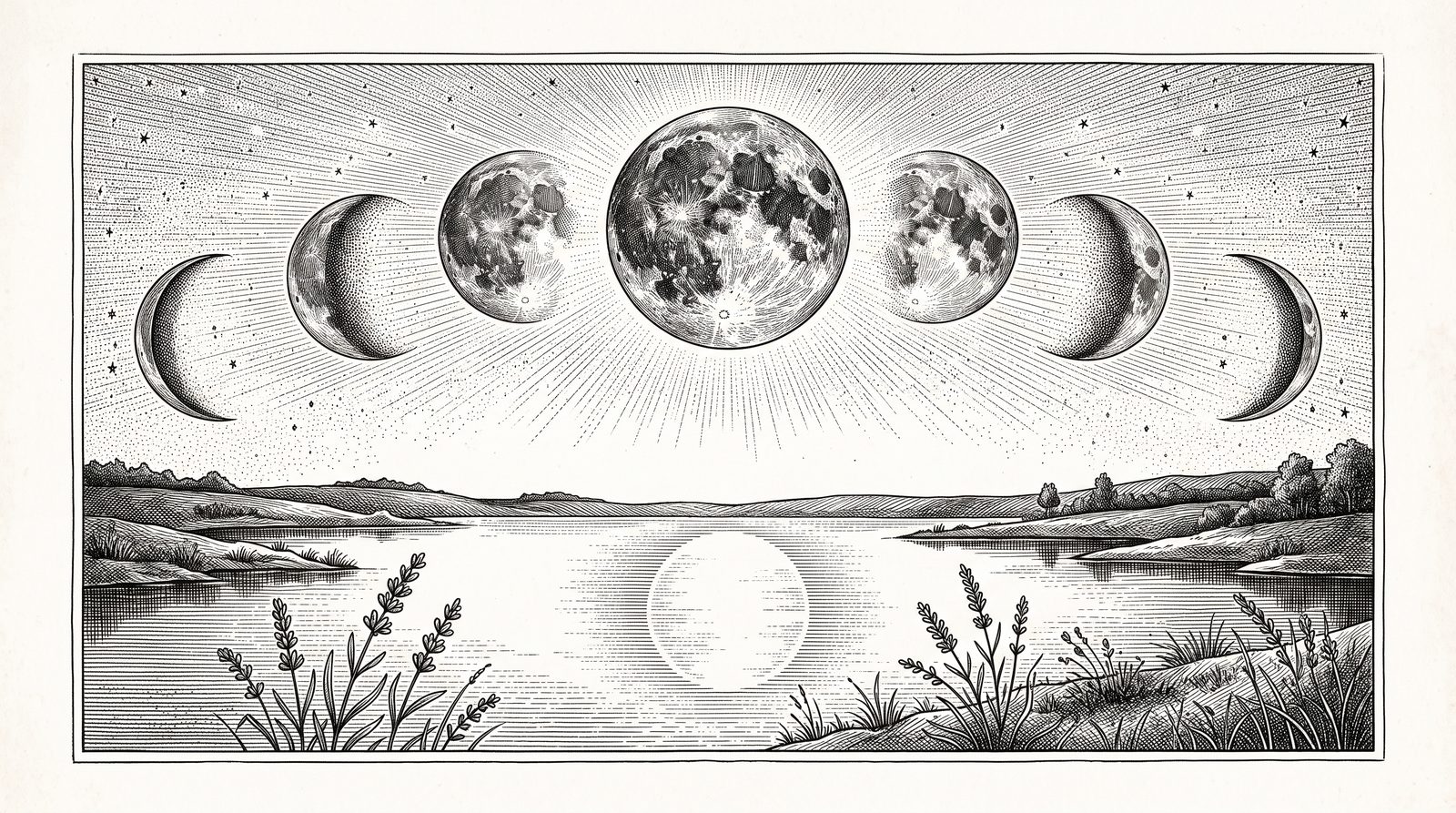
2027 has 25 moons: 13 new moons and 12 full moons. The first new moon is on January 7 in Capricorn and the first full moon, the Wolf Moon, is on January 22 in Leo. August has two new moons, and the one on August 2 brings a total solar eclipse. Below you will find every date with the time in New York, Los Angeles and London.
Introduction
The Moon is the oldest clock we have. Every month it grows, becomes full, wanes and disappears, then begins again. Many people use that rhythm to organize their lives: planting an intention at the new moon and letting something go at the full moon.
This calendar gathers all 25 moons of 2027 with their exact times, calculated from astronomical ephemerides and checked against the Royal Observatory of Belgium. They are the same dates I use in my yearbook.
Every new moon and full moon of 2027
| Date (ET) | Moon | Sign | New York (ET) | Los Angeles (PT) | London |
|---|---|---|---|---|---|
| January 7 | ●New | 17° Capricorn | 15:24 | 12:24 | 20:24 |
| January 22 | ○FullWolf Moon | 2° Leo | 07:17 | 04:17 | 12:17 |
| February 6 | ●NewAnnular solar eclipse | 18° Aquarius | 10:56 | 07:56 | 15:56 |
| February 20 | ○FullSnow MoonPenumbral lunar eclipse | 2° Virgo | 18:23 | 15:23 | 23:23 |
| March 8 | ●New | 18° Pisces | 04:29 | 01:29 | 09:29 |
| March 22 | ○FullWorm Moon | 2° Libra | 06:43 | 03:43 | 10:43 |
| April 6 | ●New | 17° Aries | 19:51 | 16:51 | 00:51 +1 |
| April 20 | ○FullPink Moon | 1° Scorpio | 18:27 | 15:27 | 23:27 |
| May 6 | ●New | 16° Taurus | 06:58 | 03:58 | 11:58 |
| May 20 | ○FullFlower Moon | 29° Scorpio | 06:59 | 03:59 | 11:59 |
| June 4 | ●New | 14° Gemini | 15:40 | 12:40 | 20:40 |
| June 18 | ○FullStrawberry Moon | 28° Sagittarius | 20:44 | 17:44 | 01:44 +1 |
| July 3 | ●New | 12° Cancer | 23:02 | 20:02 | 04:02 +1 |
| July 18 | ○FullBuck MoonPenumbral lunar eclipse | 26° Capricorn | 11:44 | 08:44 | 16:44 |
| August 2 | ●NewTotal solar eclipse | 10° Leo | 06:05 | 03:05 | 11:05 |
| August 17 | ○FullSturgeon MoonPenumbral lunar eclipse | 24° Aquarius | 03:28 | 00:28 | 08:28 |
| August 31 | ●New | 8° Virgo | 13:41 | 10:41 | 18:41 |
| September 15 | ○FullHarvest Moon | 23° Pisces | 19:03 | 16:03 | 00:03 +1 |
| September 29 | ●New | 7° Libra | 22:36 | 19:36 | 03:36 +1 |
| October 15 | ○FullHunter's Moon | 22° Aries | 09:47 | 06:47 | 14:47 |
| October 29 | ●New | 6° Scorpio | 09:36 | 06:36 | 14:36 |
| November 13 | ○FullBeaver Moon | 22° Taurus | 22:25 | 19:25 | 03:25 +1 |
| November 27 | ●New | 6° Sagittarius | 22:24 | 19:24 | 03:24 +1 |
| December 13 | ○FullCold Moon | 21° Gemini | 11:08 | 08:08 | 16:08 |
| December 27 | ●New | 6° Capricorn | 15:12 | 12:12 | 20:12 |
+1 means it is already the next day in that city; -1 means it is still the day before. US and UK times include daylight saving time.
August: two new moons and a total eclipse
There is one full moon each month in 2027, but August has two new moons: on the 2nd and the 31st. The second new moon in a calendar month is sometimes called a black moon.
The first one, on August 2 at 10° Leo, comes with a total solar eclipse, one of the longest of the century, with more than six minutes of totality at its peak. It is total in the far south of Spain and in North Africa. In the Americas the Sun has not risen yet, so it is not visible, except for a small partial eclipse at sunrise in Maine and Atlantic Canada. Everything about it is in my guide to the August 2 eclipse.
The five eclipses of 2027
- February 6, annular solar eclipse in Aquarius. The "ring of fire" is visible from Chile and Argentina, then West Africa.
- February 20, penumbral lunar eclipse in Virgo. The Moon dims only slightly; it is hard to notice with the naked eye.
- July 18, penumbral lunar eclipse in Capricorn. Also very subtle.
- August 2, total solar eclipse in Leo. The big event of the year, total in southern Spain and North Africa.
- August 17, penumbral lunar eclipse in Aquarius. It closes eclipse season.
In astrology, eclipses are moons with extra weight: they open and close chapters. In the days around them, it helps to observe more and decide less.
The full moon names
The traditional names come from the seasons of the Northern Hemisphere: the Wolf Moon in January, the Snow Moon in February, the Worm Moon in March, the Pink Moon in April, the Flower Moon in May, the Strawberry Moon in June, the Buck Moon in July, the Sturgeon Moon in August, the Harvest Moon in September, the Hunter's Moon in October, the Beaver Moon in November and the Cold Moon in December.
In 2027 the Harvest Moon falls on September 15, the full moon closest to the September equinox.
How to work with each moon
At the new moon, plant. Write one or two intentions in the present tense, as if they were already yours, and keep them. It is a good time to start something small.
At the full moon, harvest and release. Notice what has grown since the last new moon and write down what you no longer want to carry. Many people burn or tear the page as a closing.
You don't need to do it at the exact minute: the day of the moon and the day after work well. If you want a place to write it down, you can download the lunar journal for free and print it.
In short
2027 has 13 new moons, 12 full moons and five eclipses. The strongest season is August, with two new moons and the total eclipse on the 2nd. Save this page: I will link a post for each month as the year goes on.
Questions people ask
How many full moons are there in 2027?
Twelve, one each month. The first is the Wolf Moon on January 22 in Leo and the last is the Cold Moon on December 13 in Gemini.
Is there a blue moon in 2027?
No. No month in 2027 has two full moons. August does have two new moons, on the 2nd and the 31st.
When is the total solar eclipse of 2027?
On August 2, 2027, with the new moon in Leo. It is total in southern Spain and North Africa. In the Americas only Maine and Atlantic Canada catch a small partial eclipse at sunrise.
When is the Harvest Moon in 2027?
On September 15, 2027, at 19:03 New York time, in Pisces.
Do the times change depending on where I live?
Yes. The moon happens at the same instant everywhere, but the clock time changes. That is why the table includes several cities.
Misha Koku
Author of Ephemeris of the Unseen, a yearbook for 2027. I write for the curious, the sensitive and the slightly rebellious. More about me